

Mountain Biking in Ladakh: Top Routes, Tips & Complete Guide 2026
Mountain biking in Ladakh is one of those experiences that sits in a category of its own , not just in India, but anywhere on earth.
You are pedalling through a high-altitude cold desert at 3,500 to 5,000 metres, with glaciated peaks on every horizon, ancient monasteries on cliff faces above you, and roads so quiet that the sound of your own tyres on gravel is the loudest thing for miles. The landscape is dramatic in a way that no photograph fully captures. The air is thin. The climbs are genuinely hard. The descents are the kind that make experienced riders stop to catch their breath and take it all in.
Leh Ladakh bike rides attract two very different kinds of two-wheelers: those on motorcycles doing the classic Manali–Leh highway, and those on mountain bikes doing something far more intimate , slower, more physical, closer to the ground and to the landscape. This guide is for the latter. Whether you are planning a short trail from Leh, a multi-day mountain biking expedition across passes, or anything in between, here is everything you need to know.
Overview: Mountain Biking in Ladakh
Mountain biking in Ladakh has grown steadily from a niche adventure into one of the region’s most sought-after activities , and for good reason. The combination of high-altitude roads, single-track mountain trails, ancient trade routes, and some of the most dramatic scenery on the planet creates a mountain biking destination unlike any other.
Ladakh’s terrain covers an extraordinary range. Around Leh, the valley floor trails pass Buddhist monasteries, poplar-lined lanes and the Indus River , accessible, cultural, beautiful. Move upward and the terrain shifts into rocky switchbacks, high-altitude meadows, glacial streams and pass crossings that push the limits of fitness and altitude tolerance simultaneously. Higher still , at the 5,000-metre-plus passes , you are in a landscape that feels genuinely planetary: barren, vast, impossibly beautiful.
What makes Ladakh mountain biking unique is not just the altitude or the scenery but the combination of remoteness and accessibility. A morning ride from Leh can take you through monasteries that are 1,000 years old and return you to a guesthouse with hot food by afternoon. A week-long expedition can take you places that see fewer visitors per year than a good hiking trail sees in a weekend.
The routes in this guide range from half-day cultural trails accessible to intermediate riders to full multi-day expeditions that require serious preparation. All of them are extraordinary.
Top 7 Places for Mountain Biking in Ladakh
- Pangong Tso , Lakeside Ride at 4,350 Metres
Difficulty: Moderate to Challenging Best Duration: 1–2 days Distance: 30–50 km (flexible, depending on how far you ride along the lake shore) Best Time: June to September
Pangong Tso is one of those Ladakh mountain biking experiences that stays with you permanently. The lake itself sits at 4,350 metres , the ride up from Leh via Chang La (5,360m) is one of the highest mountain biking climbs accessible to visiting riders, and the descent to the lake is among the finest in the region.
Once at the lake, the trail along the southern shore gives you a ride that is almost impossible to describe honestly without it sounding like marketing: deep blue water with no other colour visible for 180 degrees of view, snow-covered peaks above, the crunch of gravel and silence everywhere else.
The route from Leh to Pangong via Chang La covers approximately 160 km each way , most riders do this as part of a multi-day route, spending a night at lakeside camps and riding back the following day. The Chang La climb itself is a serious fitness test at altitude. Allow 2–3 days in Leh for acclimatisation before attempting this route.
What to expect on the trail:
- Leh to Chang La: Long climb, paved road, significant altitude gain , this is where most riders feel the altitude most acutely
- Chang La to Pangong: Dramatic descent, some rough sections, river crossings possible in early season
- Lake shore trail: Gravel and dirt single-track, relatively flat, extraordinary scenery
- Pangong to Leh return: The Chang La climb in reverse , hard on tired legs but rewarding
Key tip: Ride the lake shore in the morning when the light is low and the water reflects the sky. Riding in the afternoon when the sun is overhead flattens the colours considerably.
- Warila–Khardung La–Nubra Valley
Difficulty: Challenging to Very Challenging Best Duration: 3–4 days Distance: 180–200 km (Leh → Nubra, returning via Khardung La or continuing) Best Time: June to September
This is the expedition route , the mountain biking experience that puts Ladakh into a completely different category from anywhere else on earth.
The classic version starts with the Warila climb from the Leh side, crosses into the upper Khardung La circuit, and descends into Nubra Valley via Khardung La (5,359m) , one of the world’s highest motorable roads and, on a mountain bike, one of the world’s finest high-altitude descents.
The descent from Khardung La into Nubra is approximately 40 km of downhill, transitioning from raw high-altitude rock and snow through juniper scrub into the warm, green, surprising width of the Nubra Valley below. From a full-suspension mountain bike, this descent is genuinely among the finest in Asia.
Nubra itself offers additional riding , along the Shyok River, through the sand dunes near Hunder, and around the Diskit area. The contrast between the Khardung La landscape and the Nubra Valley landscape , experienced in a single day’s ride , is one of mountain biking’s great sequential experiences.
What to expect:
- Warila approach: Technical climbing, loose rock sections, requires good technical skill
- Khardung La summit: The highest point , allow time to rest and acclimatise at the top before beginning the descent
- Nubra descent: 40+ km, exceptional, mix of paved and gravel road
- Nubra Valley riding: Flat to gently rolling, easier riding, culturally rich
Key tip: Do not rush the descent from Khardung La. The road is shared with vehicles and the cold at the top requires full warm gear before beginning , descents at 5,000+ metres cool you very fast, even in June.
- Spangmik, Man, Merak and the Chang La Downhill
Difficulty: Moderate to Challenging Best Duration: 2 days Distance: 50–80 km (lake area riding + Chang La descent) Best Time: June to September
The southern bank of Pangong Lake , the villages of Spangmik, Man and Merak , offers some of the most atmospheric flat-to-rolling riding in Ladakh. The trail connects the three villages along the lake shore with Pangong as a constant companion: the colour of the water changing from deep teal to cobalt blue to almost turquoise depending on the light and the angle.
From Merak, the trail begins to climb back towards Chang La. The downhill from Chang La towards the Leh side is one of the best long descents in Ladakh , approximately 30 km of descent on a mix of paved and gravel road, with the Indus Valley opening up below as you drop altitude.
What to expect:
- Spangmik to Merak: Relatively flat gravel trail along the lake shore, some sandy sections, no major technical challenges
- Merak to Chang La: The climb , sustained, high altitude, significant effort
- Chang La to Leh-side road: The reward , long, flowing descent with extraordinary panoramic views
Why this route stands out: This is the best route for riders who want the Pangong experience with more actual riding (rather than just the drive-and-camp approach). The lake shore trail between the villages is genuine single-track in places and is as beautiful as mountain biking gets anywhere in the world.
- Leh to Zingchen
Difficulty: Easy to Moderate Best Duration: Half day to full day Distance: 15–25 km one way (30–50 km return) Best Time: May to October
Leh to Zingchen is the best introductory mountain biking route in Ladakh , ideal for riders who want to experience the landscape without committing to a multi-day expedition, and perfect as the first ride after acclimatisation.
The trail follows the Leh Valley north, passing through the villages of Phyang and along the Indus River tributary, eventually reaching Zingchen , a small village at the base of the Stok Kangri approach. The route has relatively moderate elevation gain, good trail quality, and rewards with views of Leh Palace above, the Stok Range across the valley, and the classic Ladakhi village landscape of barley fields, poplar trees and whitewashed stupas.
Zingchen is also the starting point for the Markha Valley Trek , arriving here by mountain bike, continuing on foot for a day, and riding back is a satisfying way to sample two of Ladakh’s great outdoor pursuits on the same trip.
What to expect:
- Leh to Zingchen: Mostly manageable climb, good gravel road with some dirt sections, beautiful valley riding
- Cultural interest: Several small villages, stupas, and monastery ruins along the route
- Return: Enjoyable downhill back to Leh
Key tip: This is an excellent route for riders coming from the plains who are acclimatising. The elevation gain is meaningful but not extreme, and the cultural scenery keeps the ride engaging throughout.
- Skiu to Chilling , The Markha Valley Trail
Difficulty: Challenging to Expert Best Duration: 2–3 days Distance: 40–60 km (trail section only, excluding approach) Best Time: June to September
The Skiu to Chilling trail through the lower Markha Valley is the most technically demanding mountain bike route accessible from Leh , and among the finest single-track trails in the entire Himalayan region.
The trail follows the Markha River gorge through some of the most dramatic rock-walled canyon scenery in Ladakh. The riding is genuinely technical: river crossings, loose scree sections, narrow single-track above drops, and sustained technical climbing. This is not a route for casual riders , it is for experienced mountain bikers who want a Ladakh trail that demands full attention and skill.
The reward is a section of trail that feels genuinely wild and remote , very few other riders, no motorable road parallel to the trail, and a landscape that changes every few kilometres from open valley to tight gorge to high-ridge traverse.
What to expect:
- Approach: Requires getting to Skiu by vehicle or on foot (or riding the Leh–Zingchen–Skiu approach, adding another day)
- Skiu to Chilling: Technical single-track, river crossings (particularly significant in early season with snowmelt), narrow canyon sections
- Chilling to Leh: Road section along the Zanskar River to the main highway
Key tip: This trail requires a local guide who knows the Markha Valley terrain. River crossings can be genuinely dangerous in high water (July–August snowmelt peak). June and September offer the most predictable conditions.
- Stok, Stakna & Thiksey Monasteries , The Cultural Ride
Difficulty: Easy to Moderate Best Duration: Full day Distance: 40–60 km (full monastery loop from Leh) Best Time: May to October
The monastery circuit south of Leh is the best single-day mountain bike ride for those who want to combine serious riding with cultural immersion , and it delivers both in equal measure.
The route follows the Indus River valley south from Leh, passing through the villages of Choglamsar, Stakna, and Thiksey before turning east towards Stok. Each monastery is dramatically sited: Thiksey on a hilltop (the “mini Potala”) with the entire Indus Valley below, Stakna on a rocky outcrop over the river, and Stok at the base of the Stok Kangri massif with the peak visible directly above.
The riding itself is on a mix of paved road and gravel trails between villages , accessible to intermediate riders and with enough elevation variation to be genuinely satisfying. This is also the most culturally rich riding day available from Leh, with monks, prayer wheels, and the smell of juniper incense at every stop.
What to expect:
- Leh to Thiksey: Paved road with gentle climbing, the busiest section of the route
- Thiksey to Stakna: Mix of road and gravel, flatter, beautiful river views
- Stakna to Stok: Gravel trail, more remote feeling, excellent Stok Kangri views
- Return to Leh: Cross the Indus bridge at Choglamsar, short road return
Key tip: Start early to reach Thiksey for morning prayers (6 AM is ideal , the monks in the assembly hall with butter lamps and chanting is one of Ladakh’s finest experiences). The monastery also has excellent views in the early morning light.
- Leh to Sankar Gompa, Shanti Stupa & Namgyal Tsemo
Difficulty: Easy to Moderate Best Duration: Half day Distance: 15–20 km (flexible loop) Best Time: May to October , ideal as first ride after acclimatisation
This is the definitive half-day mountain bike ride for anyone based in Leh , a loop that covers three of Leh’s most significant cultural landmarks while giving a genuine mountain biking experience through the town’s most scenic surroundings.
Sankar Gompa, just 3 km north of Leh town, is a working monastery with painted walls, resident monks, and a quietness that is entirely out of proportion to its proximity to the main bazaar. The trail to it from Leh climbs through a dry streambed with views of the Leh Palace above , short but scenic.
From Sankar, a trail climbs towards Namgyal Tsemo , the dramatic ridge above Leh Palace with the Gonkhang (red temple) and Maitreya Temple at the top. The climb is steep but short; the views from the top over Leh, the Indus Valley and the Zanskar Range in every direction are the finest accessible from anywhere near the city.
Shanti Stupa, perched on a separate hilltop to the west, completes the circuit , descend from Namgyal Tsemo, cross through Changspa neighbourhood, and climb to the stupa for the most famous sunset view in all of Ladakh.
What to expect:
- Sankar Gompa trail: 20-minute ride from Leh, good gravel trail, manageable climb
- Namgyal Tsemo climb: Short but steep , altitude makes it harder than the distance suggests
- Shanti Stupa approach: Switchback trail, well-maintained, one of the most rewarding short climbs in Leh
Key tip: This route works perfectly as a Day 3 or Day 4 ride after acclimatisation , gentle enough not to strain an adjusting body, but rewarding enough to feel like a genuine mountain biking session.
Best Time for Mountain Biking in Ladakh
| Month | Conditions | Recommendation |
| May | Roads opening, snow at passes, cool temperatures | Good for Leh-area trails; Khardung La and Pangong routes may be partially restricted |
| June | All major routes open, pleasant temperatures, some snowmelt crossings | Excellent , one of the best biking months |
| July | Full season, warm, all routes accessible | Excellent , peak season but great conditions |
| August | Warm, occasional afternoon showers in some areas | Very good , stable conditions, fully open |
| September | Cool days, clear skies, post-monsoon clarity | Outstanding , many experienced riders prefer September |
| October | Cold setting in, some passes beginning to close | Good in early October; late October sees deteriorating high-pass conditions |
The best overall window for mountain biking in Ladakh is mid-June to mid-September. June gives you early-season quiet with full route access. September gives you the finest weather of the season , cool, clear skies, less crowded trails, and the soft autumn light that makes Ladakh’s landscape photography exceptional.
Duration and Cost
How Long Does a Mountain Biking Trip in Ladakh Take?
| Trip Type | Duration | What It Covers |
| Leh day rides (Stupa loop, Sankar, monastery circuit) | 1–2 days | Half-day to full-day trails from Leh base |
| Pangong Lake route | 3–4 days | Leh → Chang La → Pangong → return |
| Khardung La–Nubra expedition | 4–5 days | Leh → Khardung La → Nubra Valley → return |
| Full Ladakh MTB circuit | 10–14 days | Multiple pass crossings, Pangong, Nubra, Zanskar access |
What Does Mountain Biking in Ladakh Cost?
Bike rental in Leh (2025 rates):
| Bike Type | Daily Rate |
| Basic hardtail mountain bike | ₹700–₹1,200/day |
| Quality full-suspension MTB | ₹1,500–₹2,500/day |
| Royal Enfield 350cc (motorcycle) | ₹1,500–₹2,200/day |
| RE Himalayan 450 (motorcycle) | ₹2,500–₹3,500/day |
Guided mountain biking packages (Leh-based operators):
| Package | Duration | Cost Per Person (approx.) |
| Day ride from Leh (monastery loop or Zingchen) | 1 day | ₹2,500–₹4,000 |
| Pangong MTB package (3 days) | 3 days | ₹12,000–₹18,000 |
| Khardung La–Nubra expedition | 4–5 days | ₹20,000–₹35,000 |
| Full Ladakh MTB circuit | 10–14 days | ₹60,000–₹1,20,000 |
Guided packages typically include bike, guide, support vehicle, accommodation and meals. Self-guided riders with a rented bike cost significantly less.
Tips for Mountain Biking in Ladakh
- Acclimatise properly , this is not optional: Leh sits at 3,500 metres. Arriving and immediately riding to Khardung La or Pangong is how altitude sickness happens. Spend at least 2–3 full days in Leh doing only gentle activity before attempting any serious riding. Your performance on the bike will be dramatically better for it, and your safety is genuinely improved.
- Choose the right bike for the route: Hardtail bikes (front suspension only) work well for paved or smooth gravel routes , the monastery circuit, Leh to Zingchen, and valley floor trails. Full-suspension bikes are necessary for the Skiu–Chilling trail, technical descents, and any route with significant off-road sections. Confirm what you are renting before departure.
- Carry significantly more water than you think you need: At altitude, dehydration accelerates rapidly , and exertion on a mountain bike increases it further. Carry a minimum of 3 litres on any day ride. ORS sachets are useful for longer rides where sweat loss is high.
- Carry a full puncture kit and basic tools: Ladakh’s trails have sharp rocks. Punctures are common. A tube, levers, patches, a multi-tool, and a small pump should be in every rider’s pack regardless of route length. On multi-day expeditions, carry two spare tubes.
- Dress in layers , the temperature drops fast: A June morning in Leh feels manageable. The top of Khardung La at the same time feels near-freezing with wind chill. The descent from any high pass requires a proper windproof and thermal layer before you begin , descents at altitude are cold in a way that catches unprepared riders off guard.
- Ride with a support vehicle on longer expeditions: For multi-day routes, having a support vehicle carrying camping equipment, extra water, food, and emergency supplies transforms both safety and enjoyment. Most Leh operators offering mountain biking packages include support vehicles as standard.
- Start early every day: Mountain weather in Ladakh can shift in the afternoon , cold fronts, wind, and occasional precipitation all tend to arrive in the mid-to-late afternoon. Starting rides before 7 AM means the hardest climbing is done in the best conditions, and you are descending or in camp when the weather is least predictable.
- Tell someone your route every day: On remote single-track sections (Skiu–Chilling, high-pass routes), mobile signal is non-existent. Leave your planned route with your guesthouse or support team, along with an expected return time. This is standard safety practice for remote mountain riding anywhere , in Ladakh it is essential.
- Use sunscreen aggressively , every day, every hour: UV radiation at 3,500–5,000 metres is severe. A 90-minute uphill climb in Ladakh exposes you to more UV than a full beach day at sea level. SPF 50+ on all exposed skin, reapplied every 90 minutes. Sunburn at altitude is painful and can derail a multi-day trip.
- Respect altitude symptoms , descend if they worsen: Persistent headache, loss of coordination, confusion or chest tightness while riding are serious altitude warning signs. If symptoms worsen after rest, descend immediately. Do not push through worsening altitude sickness on a mountain bike , the combination of exertion and continued altitude gain is dangerous.
Conclusion
Mountain biking in Ladakh sits in a category that is difficult to place alongside other mountain biking destinations , because Ladakh is not just a mountain biking destination. It is a landscape of extraordinary scale, cultural depth, and physical challenge that happens to have trails and roads that reward exploration on two pedalled wheels more than almost any other mode.
The monastery circuit from Leh after acclimatisation. The descent from Khardung La into Nubra Valley. The gravel single-track along Pangong’s southern shore. The Markha gorge trail between Skiu and Chilling. These are not just good mountain bike trails , they are among the finest experiences any two-wheeled traveller can have anywhere on earth.
Come prepared: acclimatise seriously, choose your bike honestly, pack your sunscreen, carry water, and start early. The rides will take care of the rest.
Planning a mountain biking trip to Ladakh? Go2Ladakh.in offers custom biking itineraries, bike rental coordination, permit assistance and curated stays across Leh, Nubra and Pangong , built specifically for riders who want the trail, not just the road.
FAQs About Mountain Biking in Ladakh
Q1. Is mountain biking in Ladakh suitable for beginners?
Some routes are accessible to intermediate riders , particularly the Leh to Zingchen trail, the monastery circuit (Stok, Stakna, Thiksey), and the Shanti Stupa/Namgyal Tsemo loop. However, altitude makes every route harder than it looks on paper. A rider who is fit at sea level will find Ladakh trails significantly more demanding at 3,500+ metres. Beginners should acclimatise for 3 full days before attempting any riding, and should start with the shorter Leh-area routes.
Q2. When is the best time for mountain biking in Ladakh?
Mid-June to mid-September is the best window. June gives early-season quiet with fully open routes. September is many experienced riders’ preference , cooler temperatures, clear skies, less crowded trails, and stunning autumn light. July and August are peak season with good riding conditions but more traffic on the main routes.
Q3. Can I rent a mountain bike in Leh?
Yes , several operators in Leh town rent mountain bikes ranging from basic hardtails (₹700–₹1,200/day) to quality full-suspension bikes (₹1,500–₹2,500/day). Inspect the bike thoroughly before renting , check brakes, gears, tyre condition and suspension function. A poorly maintained rental bike on Ladakh’s trails is dangerous.
Q4. Do I need a permit for mountain biking in Ladakh?
The same Inner Line Permit (ILP) rules that apply to all visitors apply to mountain bikers. If your route takes you to Pangong Tso, Nubra Valley, Turtuk or Hanle, you need an ILP + Environment Fee (₹590 per person). Apply online at lahdclehpermit.in before departing Leh. Checkposts on the way to these destinations check permits for all travellers, including cyclists.
Q5. How do I handle altitude sickness during a biking trip in Ladakh?
Acclimatise in Leh for a minimum of 2–3 days before any serious riding , this is the most important preparation step. Carry Diamox (consult your doctor before travel), stay well hydrated, and avoid alcohol for the first few days. On the bike, ride at your own pace rather than trying to keep up with stronger riders. If you experience persistent headache, nausea, loss of coordination or confusion, stop riding, rest, and descend if symptoms do not improve. Altitude sickness does not discriminate by fitness level , respect it and it becomes manageable.
Trending Blogs
Similar Blogs
7-Day Ladakh Itinerary for September: Leh, Nubra Valley & Pangong Lake
One full week is enough to get a good first look at Ladakh, as long as you don’t try to cover half the region in seven days. This Ladakh itinerary 7 days plan keeps things simple: two days around Leh, followed by Nubra Valley and Pangong Lake, before returning back to Leh.
10 Reasons September Is One of the Best Months to Visit Ladakh
If you have been waiting for the right time to visit Ladakh, September deserves a place on your list. Ladakh in September has a slightly different feel from the busy summer months. The skies are clearer, the evenings start getting cold, the roads feel more peaceful and the landscape slowly begins to change with the season.
Where You Stay in Leh Ladakh
The single most confusing part of planning a Ladakh trip, after sorting out permits and altitude medicine, is figuring out where to actually stay. Leh is not a large city, but it has distinct neighbourhoods that feel completely different from each other. Stay in the wrong area for your travel style and you will spend your acclimatisation days walking uphill in thin air when you should be resting. Stay in the right one and your base will quietly make everything easier.
Trekking in Ladakh: Top 13 Treks, Costs, Tips & Complete Guide 2026
Trekking in Ladakh is different from trekking anywhere else in India , and many experienced trekkers would say it is different from anywhere else in the world. The landscape here is not forest and mist. It is not lush green meadows punctuated by waterfalls. It is something rawer and more singular: high-altitude cold desert, glaciated peaks, ancient trade routes carved through impossible terrain, river gorges so deep the sun barely reaches the bottom, and monasteries perched on clifftops that have been watching trekkers pass for a thousand years.
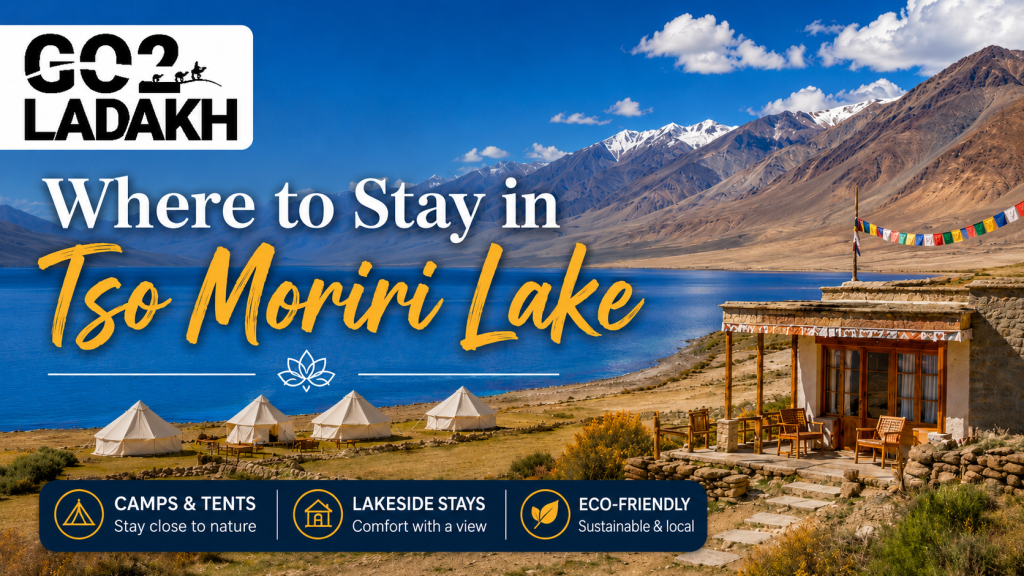
Where to Stay in Tso Moriri Lake: Complete Guide 2026
Where you stay at Tso Moriri matters in a way that is different from any other destination in Ladakh. This is not a question of choosing between a good and a better hotel. It is a question of understanding what kind of experience you want from one of the most remote overnight stops in India, and being honest with yourself about what you can comfortably handle at an altitude of 4,500+ metres with no mobile network, no ATM, and temperatures that plunge to 0°C or below every night, even in July.
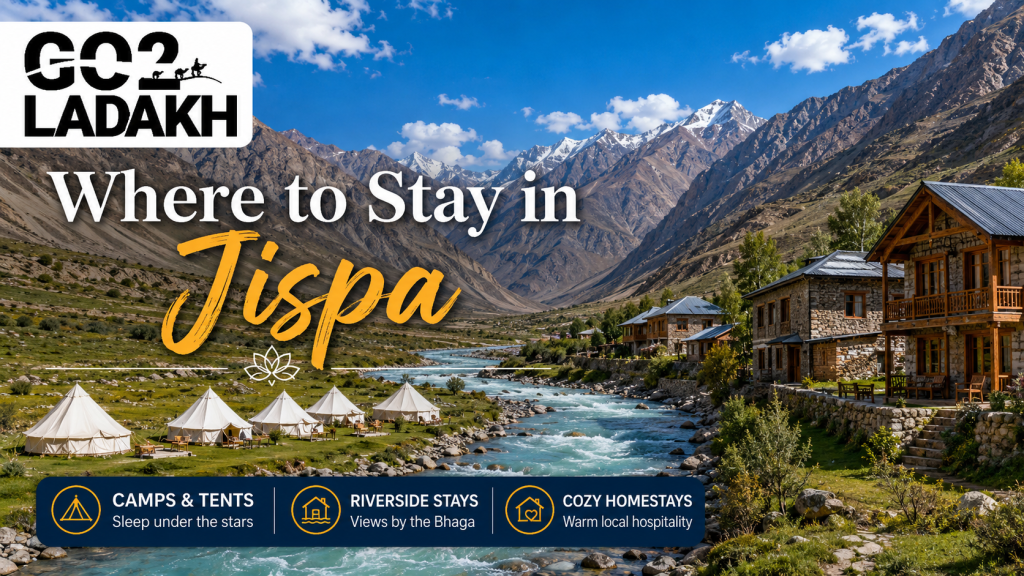
Where to Stay in Jispa: Best Hotels, Camps & Guide
Jispa is one of those places that most people pass through without really stopping — and later wish they had stayed longer. This quiet, compact village in the Lahaul Valley of Himachal Pradesh sits on the banks of the Bhaga River at 3,200 metres (10,500 feet), with snow-streaked peaks rising on every side and a silence so complete that you can hear the river from anywhere in the village.
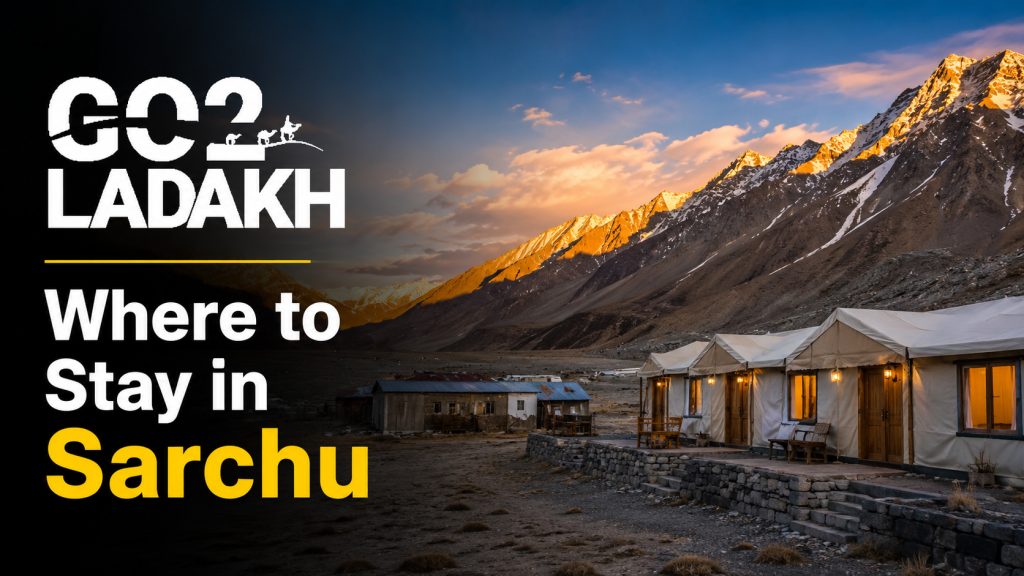
Where to Stay in Sarchu: Best Camps, Hotels & Complete Guide
Planning the complete Manali to Leh road trip? Go2Ladakh.in builds end-to-end Manali–Leh itineraries with curated overnight stops at Jispa or Sarchu, Leh hotel bookings, and real-time road status updates.
Adventure in Ladakh: Top 12 Sports & Activities Guide
Ladakh is not just a destination , it is an experience that pushes your limits, rewards your courage, and leaves you with memories that last a lifetime. Perched at an average altitude of 3,500 metres in the lap of the Himalayas and the Karakoram Range, adventure in Ladakh comes in every form imaginable , from roaring glacial rivers and ancient trekking trails to high-altitude cycling, traditional archery, and even bungee jumping over the Zanskar River.