

Where to Stay in Sarchu: Best Camps, Hotels & Complete Guide
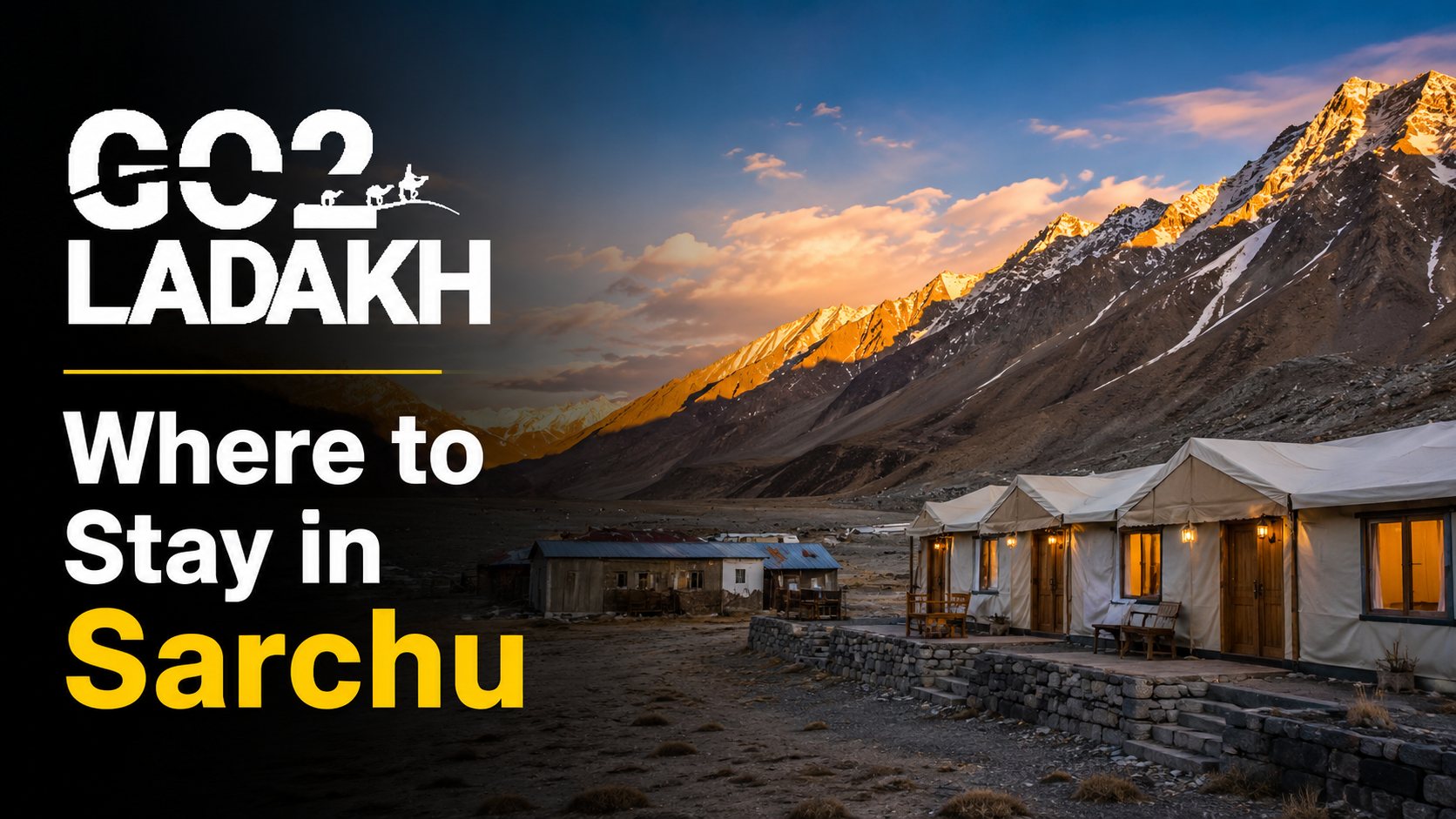
Sarchu is not a town. It is not a village. It does not have a bazaar, a petrol pump you can rely on, an ATM, or a mobile signal.
What Sarchu is — perched at 4,290 metres on the border between Himachal Pradesh and Ladakh, roughly halfway between Manali and Leh — is one of the most dramatically situated overnight camping stops in the world.
The landscape here is the kind that makes experienced Himalayan travellers go quiet. Vast open plateau, the Tsarap River cutting a silver line through brown rock, jagged peaks rising from the valley floor in every direction, and a sky at night — no light pollution within 100 km, thin air, low humidity — that is genuinely one of the finest accessible stargazing positions in Asia.
For every biker, road tripper, self-drive family, and cycling adventurer doing the Manali–Leh highway, Sarchu is the natural midpoint halt. This guide covers everything you need to know about where to stay in Sarchu — camp types, specific properties, prices, altitude realities, and the tips that make the difference between a comfortable night at 14,000 feet and a miserable one.
What Is Sarchu? Understanding Where You Are
Sarchu is a high-altitude plateau at 4,290 metres on the border of Himachal Pradesh and Ladakh, serving as the natural midpoint halt on the Manali–Leh highway. It is a temporary settlement of seasonal tented camps that comes alive between June and September, then closes entirely for winter.
Sarchu lies between the Baralacha La pass to the south and Lachulung La to the north, with the Tsarap River running through the valley below the camps. There is an Indian Army camp on the riverbank.
Sarchu is approximately 222 km from Manali and 252 km from Leh — making it genuinely the midpoint of the highway, which is why it developed as the primary halt point for travellers completing the journey over two or three days.
There are no permanent buildings in Sarchu. No hotels in the traditional sense. No guesthouses with proper walls and roofs that stay year-round. Every option you have for accommodation in Sarchu is a tent — ranging from a basic chadar (a large canvas sheet over rope, dhaba-style) to a fully furnished Swiss cottage tent with attached bathroom, proper beds, carpeted floors and a dining tent.
Sarchu is open from mid-June to late September only. Outside these dates, the highway is closed, the camps are gone, and Sarchu reverts to empty plateau.
The Critical Altitude Warning About Sarchu
Before covering accommodation, this must be said clearly: Sarchu sits at 4,290 metres, which is actually higher than Leh (3,500m). Many travellers experience altitude sickness here, especially those coming straight from Manali, because the ascent to Sarchu is rapid — you gain over 1,500 metres of altitude in a single day’s drive from Manali.
It is better to stop at Keylong or Jispa the night before reaching Sarchu, giving your body time to adjust to the rising altitude gradually before committing to a night at 4,290m.
The symptoms at Sarchu can include: headache, nausea, disturbed sleep, breathlessness on exertion, and loss of appetite. This is not rare — it is the typical altitude experience at this elevation for travellers ascending rapidly from Manali.
Practical advice:
- Carry Diamox (consult your doctor before travel) — starting 24 hours before your Sarchu night significantly improves acclimatisation
- Drink 3–4 litres of water on the day you arrive at Sarchu
- Avoid alcohol the night at Sarchu — it dramatically worsens altitude symptoms
- Do not attempt strenuous activity after arriving at camp — eat, rest, sleep
- If symptoms worsen overnight (persistent headache, vomiting, confusion), consider descending
Types of Accommodation in Sarchu
All Sarchu accommodation is tented. Understanding the difference between the types saves you from the most common Sarchu mistake: booking the cheapest option and spending a night in freezing discomfort at 4,290m.
Chadar Tents / Dhaba Tents — Budget (₹500–₹1,500 per person)
The most basic Sarchu accommodation — large canvas sheets forming a communal sleeping space, with shared or no attached bathroom facilities, basic bedding, and food from the dhaba attached.
Chadar tents are a valid option for very budget-conscious travellers or those who are self-sufficient (own sleeping bags rated to -10°C or below). They are not comfortable. Shared facilities at 4,290m in temperatures that drop to 0°C or below at night require some stoicism.
There are several chadar tents and dhabas in Sarchu that greatly suit budget travellers — they will provide basic accommodation at the lowest price point on the highway.
Who it suits: Budget bikers, solo backpackers with proper sleeping gear, very short transit stops where you are departing before 6 AM Who it does not suit: Families, anyone without their own proper sleeping bag, altitude-sensitive travellers who need a warm room to sleep properly
Standard Swiss Tent Camps — Mid-Range (₹2,000–₹4,000 per person)
The standard Sarchu camp experience — a proper canvas Swiss tent (single or double occupancy) with an attached bathroom (or semi-attached), a bed with warm bedding, electricity for a few hours in the evening, and a dining tent serving buffet meals.
The camps in Sarchu are well equipped with facilities like double beds, attached bathrooms, running water and other possible amenities — they are not just another tented accommodation, they are well-equipped and no less than a normal hotel room where food is offered.
This is the category that most Sarchu reviews are based on — and quality varies considerably. The key questions to ask before booking any standard Swiss tent camp:
- Is the bathroom physically attached to the tent or in a shared block?
- What bedding is provided — how many blankets?
- What time does electricity switch on and off?
- Is hot water available and how (bucket or running)?
- Is the camp fenced / secure?
Who it suits: Most travellers doing the Manali–Leh route who want comfort without the premium price Price reality check: ₹2,500–₹3,500 per person with dinner and breakfast is the reasonable mid-range expectation in peak season (July–August)
Premium / Luxury Tent Camps — Premium (₹4,000–₹8,000 per person)
The top tier of Sarchu accommodation — larger Swiss cottage tents with proper attached bathrooms, quality bedding (sometimes including electric blankets or hot water bottles), better insulation, and significantly better dining.
The Yunam Camp Sarchu is definitely in the luxury camp category and hence probably one of the best accommodation options in the area — each tent has an attached bathroom with running cold water and flushing toilet, with hot water supplied in a large bucket after arrival. There is also electric lighting to the tents and dinner is a typical buffet with plenty of food.
Premium camps in Sarchu are worth the extra cost for travellers who are sensitive to cold or altitude, for families with children, for couples wanting a more comfortable Sarchu experience, and for anyone who has done a cheap Sarchu camp before and knows the difference the upgrade makes.
Who it suits: Families, couples, altitude-sensitive travellers, those who want comfort at altitude What justifies the premium: Attached flushing toilets, quality blankets, warmer tents, better food, reliable electricity
Best Camps in Sarchu: What to Know
Yunam Camp Sarchu (Formerly Goldrop Camp)
Category: Premium / Luxury Price: ₹4,500–₹7,500 per person (with meals)
The Yunam Camp (renamed from the long-running Goldrop Camp) is consistently cited as one of the finest accommodation options at Sarchu. The owner operator provides the best facility, comfort, food and help he can — the staff are very gracious, helpful and caring.
Each tent has an attached bathroom with running cold water and flushing toilet. Hot water in buckets is provided on request. Electric lighting functions for several hours in the evening. The dining tent serves a proper buffet. For a camp at 4,290m on a remote highway, this represents genuine quality.
Recommended for: Families, couples, first-time Manali–Leh travellers wanting their best possible Sarchu night
Marmote Camps Sarchu
Category: Premium Price: ₹4,000–₹7,000 per person (with meals) Location: Leh Manali Highway, Sir Bhum Chun, Sarchu
Marmote Camps Sarchu offers luxury tents with mountain and river views. Each unit features a work desk, seating area, and free toiletries. Guests enjoy a continental buffet breakfast, free on-site parking, and a 24-hour front desk with tour desk facilities.
The continental breakfast option and the tour desk facilities are notable for Sarchu — these are not standard across all camps in the area. The mountain and river view positioning makes Marmote one of the most scenic Sarchu camps.
Recommended for: Travellers wanting the best mountain-view camp position, those wanting a slightly more hotel-feel experience in a tent setting
Himalayan Routes Camp Sarchu
Category: Mid-Range to Premium Price: ₹3,000–₹5,500 per person (with meals)
Himalayan Routes Camp Sarchu offers comfortable ground-floor units with private bathrooms, carpeted floors, and garden or mountain views. Each unit includes a dining area and a private balcony. Guests enjoy a buffet breakfast and a restaurant serving Indian cuisine for dinner. Located on the Manali Leh Road with free on-site parking, the camp is highly rated for attentive staff and excellent service.
The private balcony attached to each tent unit is an unusual and welcome feature for Sarchu — it makes the morning mountain views significantly more enjoyable. Cash-only payment.
Recommended for: Indian families and groups wanting reliable mid-to-premium camping with good food and helpful staff
Dorje Camps
Category: Mid-Range Price: ₹2,500–₹4,500 per person (with meals)
Dorje Camps is a camping facility made up of 20 Swiss Cottage Tents of ample proportions, furnished with comfortable amenities including double beds, carpeted flooring, attached bathrooms, hot water supplies and more.
One of Sarchu’s longer-established named camps. Reviews note that staff are friendly and helpful, and the Swiss cottage format is proper. Some reviews note that rooms can be on the smaller side relative to expectations. For the price point, it represents a fair mid-range choice with attached bathroom facilities.
Recommended for: Mid-range travellers wanting a named, bookable camp with attached facilities at a reasonable price
Jispa — The Smart Alternative to Sarchu
Before committing to a Sarchu overnight, consider this seriously: It is better to stop at Keylong or Jispa the night before reaching Sarchu, giving your body time to adjust to the rising altitude before spending a night at 4,290m. Jispa is 90 km from Sarchu and sits at approximately 3,200m — over 1,000m lower than Sarchu.
Jispa offers proper hotel-standard accommodation (not just tents), at significantly lower altitude, with better facilities and lower prices. Staying at Jispa on Day 1 and then continuing to Leh or stopping briefly at Sarchu for lunch on Day 2 is the strategy most altitude-experienced Manali–Leh travellers prefer.
The Jispa alternative makes sense for:
- First-time high-altitude travellers
- Families with elderly members or children
- Anyone with any history of altitude sickness
- Those who want a proper bed rather than a tent for their highway night
Sarchu Camp Comparison Table
| Camp | Category | Bathroom | Price (per person) | Best For |
| Yunam Camp (ex-Goldrop) | Premium | Attached, flushing | ₹4,500–₹7,500 | Families, couples, first-timers |
| Marmote Camps | Premium | Attached | ₹4,000–₹7,000 | Mountain views, premium comfort |
| Himalayan Routes Camp | Mid-Premium | Private attached | ₹3,000–₹5,500 | Families, groups, good dining |
| Dorje Camps | Mid-Range | Attached | ₹2,500–₹4,500 | Budget-mid, named bookable camp |
| Chadar Dhaba Tents | Budget | Shared / basic | ₹500–₹1,500 | Solo bikers, own sleeping bag |
| Self-camping | Free | None (own gear) | ₹0–₹300 | Experienced campers only |
What to Expect at Any Sarchu Camp
- Electricity: Available for 3–5 hours in the evening (typically 6 PM–10 PM) via generator. After that, darkness. Carry a headtorch — this is non-negotiable at Sarchu.
- Hot water: Bucket hot water provided on request at premium camps. Running hot water at the tap is rare. Budget 30–45 minutes for the camp to prepare hot water after your request.
- Food: All camps serve dinner and breakfast as part of the package (usually buffet style). The food is simple — dal, rice, sabzi, roti, occasionally eggs — but genuinely hot and filling. This matters at 4,290m where your body is working harder than usual. Do not skip dinner even if your appetite is suppressed by altitude.
- Mobile signal: There is no mobile signal at Sarchu. Emergency satellite phones may be available at some premium camps. Download offline maps before leaving Manali or Keylong. Save your camp’s contact number offline before you lose signal.
- ATM: There is absolutely no ATM service available in Sarchu. Carry all required cash from Manali or Keylong. The camps are cash-only.
- Petrol: The next reliable petrol pump after Sarchu (towards Leh) is at Karu before Leh township. However, if you are in urgent need of petrol, you can get it from any of the dhaba tents at Zing Zing Bar, Pang and Sarchu at significantly higher prices. Fill up completely in Keylong or Manali before the Sarchu leg.
Sarchu Weather: What to Pack
Sarchu has a cold and dry climate — summer daytime temperatures range from 5°C to 20°C, but night-time temperatures can drop below freezing even in peak summer.
This is the most important packing reality about Sarchu: the daytime temperature in July might feel like 18°C–20°C. By 8 PM it is under 10°C. By midnight it is likely below 0°C. Travellers who pack for “summer” and do not account for this have the most difficult Sarchu nights.
What to have ready for your Sarchu night:
- Thermal base layer (top and bottom) — wear this to sleep
- Fleece mid-layer — wear this over thermals in the evening
- Down jacket or heavy synthetic insulation — you will need this at camp after sunset
- Warm hat and gloves — even in July, needed after dark at 4,290m
- Quality sleeping bag — if camping independently, rated to at least -10°C. Camp bedding in premium camps is usually adequate.
- Headtorch — essential after generator hours
Best Time to Stay at Sarchu
Sarchu camps are open from mid-June to late September — outside these dates, the Manali–Leh highway is closed due to snow and the camps are completely packed up.
| Month | Conditions | Camp Status | Recommendation |
| Mid-June | Opening season, may have snow on passes | Camps opening | Check highway status before departing |
| July | Peak season, all camps open, warmest nights | Fully operational | Best overall experience |
| August | Good conditions, busy highway | Fully operational | Good, slightly less crowded than July |
| September | Cool, clear, fewer travellers | Most camps open | Excellent — quiet, clear skies |
| October | Closing season, cold | Camps closing | Not recommended — most camps closed |
Best overall month for Sarchu: July for warmth and full camp operation; September for quieter roads and spectacular skies.
Tips for Staying in Sarchu
Carry cash — no ATM, no UPI, no card: This cannot be overstated. Every transaction at Sarchu is cash. Carry enough from Manali or Keylong for your camp cost (₹2,500–₹7,500 per person depending on category), plus extra for any contingencies.
Confirm attached bathroom before booking: The difference between a camp with an attached flushing toilet and one where the toilet is a 50-metre walk away at -5°C and 4,290m altitude at 3 AM is enormous. This is the single most important booking question.
Do not over-exert after arriving at camp: Altitude sickness is a real risk at Sarchu. After reaching camp, rest in your tent for 30–60 minutes, drink water, eat a light snack, and avoid any physical effort beyond a slow walk. Save the exploration for the morning when you have slept.
Do not skip dinner — even if you feel nauseous: Loss of appetite is a common altitude symptom. Eat anyway — your body needs fuel to stay warm overnight at this altitude. Hot soup and rice will help more than you expect.
Keep your water bottle inside your sleeping bag at night :Water freezes at Sarchu overnight. Keep a full water bottle in your sleeping bag to prevent it freezing and to have drinking water immediately available when you wake in the night with a dry altitude-mouth.
Bring your own headtorch with fresh batteries: Camp power cuts at 9–10 PM. The walk to the toilet tent at midnight is not safely done without a torch. This is not an optional item at Sarchu.
Start the Leh leg early the next morning: The drive from Sarchu to Leh (approximately 252 km) takes 8–10 hours including the Tanglang La crossing. Departing by 6–7 AM gives you the best road conditions (fewer vehicles), the best morning light on the Morey Plains, and allows you to arrive in Leh by early afternoon with time to acclimatise.
Consider Jispa instead if altitude-sensitive: Jispa at 3,200m — 90 km and 1,100m lower than Sarchu — has proper hotel accommodation, reliable facilities, and a significantly better altitude experience. For first-time high-altitude travellers, altitude-sensitive individuals, or families with young children or elderly members, Jispa is the better overnight stop. You can still experience Sarchu’s landscape by stopping briefly during the day without committing to a night at 4,290m.
Conclusion
Sarchu is not a comfortable place to spend a night by any conventional standard. It is cold, high, remote, and without any of the urban infrastructure that makes lodging easy. The toilet may require a cold walk. The water for your morning wash will come in a warm bucket. The power will cut before you fall asleep.
And it is still worth doing.
The sky above Sarchu after midnight — no signal, no light pollution, no noise from the highway, the Milky Way visible from horizon to horizon — is the kind of thing that makes the cold tent and the 4,290-metre headache entirely worthwhile in retrospect. The dawn over the Tsarap valley, with the first light hitting the brown-red cliffs and the river glinting below, before a single vehicle has started moving — this is the Manali–Leh highway at its most extraordinary.
Choose a good camp. Confirm the attached bathroom. Pack your thermals and your headtorch. Carry cash. Drink water instead of chai until you have slept.
Then watch the sky.
Planning the complete Manali to Leh road trip? Go2Ladakh.in builds end-to-end Manali–Leh itineraries with curated overnight stops at Jispa or Sarchu, Leh hotel bookings, and real-time road status updates.
FAQs About Where to Stay in Sarchu
Q1. Are there any hotels in Sarchu?
No — there are no permanent buildings or traditional hotels in Sarchu. All accommodation is seasonal tented camps that operate from mid-June to late September only. The camps range from basic chadar dhaba tents (₹500–₹1,500) to premium Swiss cottage tent camps with attached bathrooms (₹4,000–₹8,000 per person with meals).
Q2. Should I stay in Sarchu or Jispa on the Manali–Leh route?
For most travellers — especially those doing the route for the first time or those with any altitude sensitivity — Jispa (3,200m, 90 km before Sarchu) is the better overnight stop. It offers proper hotel accommodation at significantly lower altitude, giving your body a gentler acclimatisation before the higher passes. If you are experienced at altitude and want the full Sarchu experience, the premium camps are genuinely worth it.
Q3. How cold does Sarchu get at night?
Even in peak summer (July–August), Sarchu night temperatures regularly drop to 0°C or below. In June and September, sub-zero nights are the norm. Thermal layers, a warm jacket, and a quality sleeping bag (if self-camping) or the camp’s quality bedding (if in a premium tent) are essential.
Q4. Is there mobile signal at Sarchu?
No. There is no mobile signal at Sarchu — from any network. Emergency satellite phones may be available at some premium camps, but standard smartphone communication is not possible. Download offline maps (Google Maps or Maps.me) before you leave Keylong or Jispa.
Q5. Do I need to book Sarchu camps in advance?
Unlike Pangong or Leh hotels, most Sarchu camps can be booked on arrival during off-peak periods. However, for July and August when the Manali–Leh highway is at its busiest, and specifically for the premium camps (Yunam, Marmote, Himalayan Routes), booking 1–2 weeks ahead is recommended to secure a proper attached-bathroom tent. Basic camps can usually accommodate walk-ins.
Q6. What is the price of camps in Sarchu?
Prices in 2025 range from ₹500–₹1,500 per person for basic chadar/dhaba tents (shared facilities) to ₹2,500–₹4,500 for mid-range Swiss tent camps with attached bathrooms, to ₹4,000–₹8,000 for premium camps with quality bedding, proper dining and full facilities. Prices typically include dinner and breakfast.
Q7. Is altitude sickness a problem in Sarchu?
Yes — Sarchu at 4,290m is actually higher than Leh (3,500m). Travellers coming from Manali (2,050m) gain over 2,000m of altitude in a single day. Altitude sickness symptoms (headache, nausea, breathlessness, disrupted sleep) are common. Diamox (consult your doctor), adequate hydration, no alcohol, no exertion on arrival, and an early start the previous day from Keylong/Jispa all reduce the severity significantly.
Q8. What is there to do in Sarchu?
Sarchu has no specific tourist attractions in the conventional sense. The draw is the landscape — vast, dramatic, unlike anything at lower altitudes — and the night sky. Stargazing from Sarchu after camp lights go off is extraordinary. A short walk along the Tsarap River at dawn, before the highway traffic begins, is one of the quietest and most beautiful morning walks available on the entire Manali–Leh journey.
Q9. Where should I stay in Sarchu?
Sarchu has no permanent buildings — all accommodation is seasonal tented camps (June–September only). For the best Sarchu experience: choose a camp with an attached bathroom and proper insulation — the temperature drops below freezing at night even in July. Swiss-tent camps with attached facilities (₹2,500–₹5,000 per person) are significantly more comfortable than basic chadar tents (₹500–₹1,500). The Yunam Camp (formerly Goldrop) and Marmote Camps are among the most consistently reviewed premium options. Do not book without confirming attached bathroom and heating.
Trending Blogs
Similar Blogs
7-Day Ladakh Itinerary for September: Leh, Nubra Valley & Pangong Lake
One full week is enough to get a good first look at Ladakh, as long as you don’t try to cover half the region in seven days. This Ladakh itinerary 7 days plan keeps things simple: two days around Leh, followed by Nubra Valley and Pangong Lake, before returning back to Leh.
10 Reasons September Is One of the Best Months to Visit Ladakh
If you have been waiting for the right time to visit Ladakh, September deserves a place on your list. Ladakh in September has a slightly different feel from the busy summer months. The skies are clearer, the evenings start getting cold, the roads feel more peaceful and the landscape slowly begins to change with the season.
Where You Stay in Leh Ladakh
The single most confusing part of planning a Ladakh trip, after sorting out permits and altitude medicine, is figuring out where to actually stay. Leh is not a large city, but it has distinct neighbourhoods that feel completely different from each other. Stay in the wrong area for your travel style and you will spend your acclimatisation days walking uphill in thin air when you should be resting. Stay in the right one and your base will quietly make everything easier.
Trekking in Ladakh: Top 13 Treks, Costs, Tips & Complete Guide 2026
Trekking in Ladakh is different from trekking anywhere else in India , and many experienced trekkers would say it is different from anywhere else in the world. The landscape here is not forest and mist. It is not lush green meadows punctuated by waterfalls. It is something rawer and more singular: high-altitude cold desert, glaciated peaks, ancient trade routes carved through impossible terrain, river gorges so deep the sun barely reaches the bottom, and monasteries perched on clifftops that have been watching trekkers pass for a thousand years.
Where to Stay in Tso Moriri Lake: Complete Guide 2026
Where you stay at Tso Moriri matters in a way that is different from any other destination in Ladakh. This is not a question of choosing between a good and a better hotel. It is a question of understanding what kind of experience you want from one of the most remote overnight stops in India, and being honest with yourself about what you can comfortably handle at an altitude of 4,500+ metres with no mobile network, no ATM, and temperatures that plunge to 0°C or below every night, even in July.
Where to Stay in Jispa: Best Hotels, Camps & Guide
Jispa is one of those places that most people pass through without really stopping — and later wish they had stayed longer. This quiet, compact village in the Lahaul Valley of Himachal Pradesh sits on the banks of the Bhaga River at 3,200 metres (10,500 feet), with snow-streaked peaks rising on every side and a silence so complete that you can hear the river from anywhere in the village.
Adventure in Ladakh: Top 12 Sports & Activities Guide
Ladakh is not just a destination , it is an experience that pushes your limits, rewards your courage, and leaves you with memories that last a lifetime. Perched at an average altitude of 3,500 metres in the lap of the Himalayas and the Karakoram Range, adventure in Ladakh comes in every form imaginable , from roaring glacial rivers and ancient trekking trails to high-altitude cycling, traditional archery, and even bungee jumping over the Zanskar River.
Mountain Biking in Ladakh: Top Routes, Tips & Complete Guide 2026
Mountain biking in Ladakh is one of those experiences that sits in a category of its own , not just in India, but anywhere on earth.
You are pedalling through a high-altitude cold desert at 3,500 to 5,000 metres, with glaciated peaks on every horizon, ancient monasteries on cliff faces above you, and roads so quiet that the sound of your own tyres on gravel is the loudest thing for miles. The landscape is dramatic in a way that no photograph fully captures. The air is thin. The climbs are genuinely hard. The descents are the kind that make experienced riders stop to catch their breath and take it all in.