

Trekking in Ladakh: Top 13 Treks, Costs, Tips & Complete Guide 2026
Trekking in Ladakh is different from trekking anywhere else in India , and many experienced trekkers would say it is different from anywhere else in the world. The landscape here is not forest and mist. It is not lush green meadows punctuated by waterfalls. It is something rawer and more singular: high-altitude cold desert, glaciated peaks, ancient trade routes carved through impossible terrain, river gorges so deep the sun barely reaches the bottom, and monasteries perched on clifftops that have been watching trekkers pass for a thousand years.
At 3,500 metres before you even take your first step on a trail, Ladakh challenges your body from the moment you land. It asks you to slow down, to breathe deliberately, to earn the view. And then it gives you views that make every difficult step entirely worth it.
This guide covers the 13 best treks in Leh Ladakh , from the “Baby Trek” of Sham Valley (perfect for first-timers) to the frozen Zanskar River of the Chadar Trek (one of the world’s most extraordinary winter expeditions). Each trek is listed with altitude, duration, best season, difficulty, cost and highlights, so you can match the right trail to your fitness, time, and budget.
Overview: Trekking in Ladakh
Ladakh has emerged as one of the world’s premier trekking destinations , and it is not hard to understand why. The region sits at the convergence of the Himalayan, Karakoram and Zanskar mountain ranges, creating a landscape of extraordinary variety: snow-covered passes above 5,000 metres, deep river gorges carved by the Indus and Zanskar, high-altitude meadows where nomadic Changpa herders graze their flocks, and ancient Silk Road villages that have seen centuries of traders, pilgrims and explorers pass through.
Trekking in Leh Ladakh covers an equally extraordinary range of difficulty and character. The Sham Valley Trek , known as Ladakh’s “Baby Trek” , takes first-time trekkers through monastery villages and apricot orchards at manageable altitudes. The Markha Valley Trek, one of India’s finest classic multi-day routes, combines cultural immersion with the Kongmaru La high-pass crossing. The Chadar Trek, done only in January and February on the frozen Zanskar River, is unlike any other trek on earth.
What all Ladakh treks share is the altitude challenge. Leh sits at 3,500 metres, and most trekking routes operate between 3,700 metres and 5,500 metres. The thin air at these elevations means that even experienced trekkers from lower altitudes need a minimum of 2–3 full rest days in Leh before beginning any trail. This is not optional , it is the single most important preparation step for any Ladakh trekking trip.
The best season for trekking in Ladakh is June to September for most routes, with the Chadar Trek operating exclusively in January–February. Ladakh trekking costs range from ₹15,000 to ₹1,20,000+ per person depending on the route, duration, and whether you go guided or self-supported.
Ladakh Treks by Difficulty Level
EASY TREKS IN LADAKH
Suitable for: First-time trekkers, families, those new to high altitude. Fitness requirement: Moderate. No prior trekking experience essential.
1. Sham Valley Trek (Baby Trek)
| Detail | Info |
| Altitude | 3,050m – 3,800m (10,000–12,500 ft) |
| Duration | 3–4 days |
| Best Season | May–October (also winter for snow leopard sightings) |
| Difficulty | Easy |
| Cost | ₹8,000–₹15,000 per person |
| Distance | 32 km |
Overview: The Sham Valley Trek , known locally and widely as Ladakh’s “Baby Trek” , is the definitive entry-level trekking experience in Ladakh. Perfect for beginners or those short on time, it delivers authentic Ladakhi experiences without extreme altitude or physical demands. The trail passes through the villages of Likir, Yangthang, Hemis Shukpachan and Temisgam , ancient communities where time moves differently, apricot orchards line stone lanes, and monastery gongs mark the hours.
Highlights:
- Likir Monastery , giant Maitreya Buddha, one of Ladakh’s finest smaller monasteries
- Apricot orchards of Yangthang and Hemis Shukpachan , in full bloom/leaf May–August
- Homestay stays with Ladakhi families , the most culturally immersive accommodation on any Ladakh trek
- Low altitude relative to other Ladakh routes , far less altitude sickness risk
- Scenic Indus Valley views throughout
Tips: This is an excellent first Ladakh trek, and an excellent trek for older travellers or those with any altitude sensitivity. The homestay network is well-established and the hospitality is genuine. The winter version of this trek (November–February) offers snow leopard sighting possibilities in the Rumbak area nearby.
2. Lamayuru to Alchi Trek
| Detail | Info |
| Altitude | 2,680m – 4,900m (8,800–16,100 ft) |
| Duration | 4–5 days |
| Best Season | June–October |
| Difficulty | Easy to Moderate |
| Cost | ₹12,000–₹20,000 per person |
| Distance | 55–60 km |
Overview: The Lamayuru to Alchi Trek connects two of Ladakh’s finest cultural landmarks , Lamayuru Monastery (one of the oldest in Ladakh, built on a lunar-landscape moonscape) with Alchi Monastery (home to some of the oldest Buddhist murals in the entire Himalayan region). The route passes through the dramatic Ridzong and Wullar valleys and offers a genuine mix of high-altitude terrain and cultural depth.
Highlights:
- Lamayuru Monastery , 11th century, dramatic cliff-top setting, one of Ladakh’s most atmospheric
- Alchi Monastery , famous for its exceptionally preserved 10th–12th century Buddhist murals
- Dramatic Ladakhi canyon and valley scenery throughout
- Remote villages with minimal tourist presence
- Karakoram range views from higher sections
Tips: This route is a good step up from the Sham Valley Trek for travellers who want more terrain variety and cultural depth. The Alchi murals are genuinely extraordinary , allow time to appreciate them properly at the end of the trek.
3. Ripchar Valley Trek
| Detail | Info |
| Altitude | 3,500m – 4,800m (11,500–15,700 ft) |
| Duration | 4–5 days |
| Best Season | July–September |
| Difficulty | Easy to Moderate |
| Cost | ₹12,000–₹18,000 per person |
| Distance | 45–50 km |
Overview: The Ripchar Valley Trek is one of Ladakh’s more underrated routes , a relatively accessible trek that passes through the dramatic Ripchar Valley gorge, connecting Lamayuru with Wanla and offering extraordinary canyon scenery that few trekking routes in India can match. The red and yellow canyon walls of the Ripchar gorge are among Ladakh’s most visually striking landscapes.
Highlights:
- Ripchar Valley gorge , dramatic layered rock canyon walls in red and ochre
- Wanla village and its multi-storey monastery
- Relatively off-the-beaten-path , few other trekkers on this route
- Good acclimatisation introduction to Lamayuru-area trekking
Tips: This route is best combined with a Lamayuru base , spending a night at the monastery before beginning the trek adds considerable cultural depth to the experience.
MODERATE TREKS IN LADAKH
Suitable for: Trekkers with some previous experience at altitude or on multi-day routes. Good fitness required. Prior high-altitude experience recommended.
4. Markha Valley Trek
| Detail | Info |
| Altitude | 3,500m – 5,200m (11,500–17,100 ft) |
| Duration | 7–8 days |
| Best Season | June–September |
| Difficulty | Moderate |
| Cost | ₹18,000–₹28,000 per person |
| Distance | 70–80 km |
Overview: The Markha Valley Trek is Ladakh’s most popular and arguably most complete multi-day trek , and the reputation is entirely deserved. The trail runs through the heart of Hemis National Park, following the Markha River through a valley of ancient villages, crossing high passes, and finishing with the ascent of Kongmaru La (5,200m) , one of the finest high-pass experiences in Indian trekking.
The Markha Valley is also known as Ladakh’s “tea-house trek” for its network of homestays and parachute café camps along the route , giving trekkers the social fabric of a trekking trail alongside the solitude of a remote valley.
Highlights:
- Kongmaru La (5,200m) , the high-pass finale, with panoramic views of Kang Yatse, Dzo Jongo and Stok Kangri
- Hemis National Park , one of the world’s finest snow leopard habitats (rarely seen in summer, but the wildlife is present)
- Traditional Ladakhi village life , Markha, Hankar, Sara, Skiu
- Spectacular Kang Yatse peak views from Nimaling camping ground
- River crossings (particularly significant in July–August snowmelt)
Tips: Book your Hemis National Park permit in advance (available at the park office in Leh). The route is well-supported with homestays, but early season (June) and late season (September) have fewer facilities open. The Nimaling camping ground , the highest point before Kongmaru La , is one of the finest places to camp in all of Ladakh.
5. Lamayuru to Stok Kangri
| Detail | Info |
| Altitude | 3,500m – 6,153m (11,500–20,187 ft) |
| Duration | 14–16 days |
| Best Season | July–September |
| Difficulty | Moderate to Challenging |
| Cost | ₹30,000–₹55,000 per person |
| Distance | 130–140 km |
Overview: The Lamayuru to Stok Kangri traverse is one of Ladakh’s great long-distance trekking routes , a cross-valley expedition that begins at the ancient Lamayuru Monastery and ends with the ascent of Stok Kangri, once the highest non-technical trekking peak in India. The route crosses multiple high passes, traverses remote valleys, and builds towards a technically demanding summit.
Important 2025 update: Stok Kangri summit access remains restricted due to conservation concerns from the Ladakh administration and the wildlife department. The ban was implemented to allow the region to recover from environmental stress caused by overcrowding. Check current permit status before booking this route, as regulations may have been updated. The trek route itself (without the Stok Kangri summit) remains an extraordinary journey.
Highlights:
- Lamayuru to Stok traverse , one of Ladakh’s most complete cross-valley routes
- Multiple high-pass crossings including Konke La, Ganda La and Stok La
- Remote camping with no road access for several days
- Stok Palace and Stok Village at the end of the route
- Outstanding views of the Zanskar range throughout
6. Lamayuru to Chilling Trek
| Detail | Info |
| Altitude | 3,400m – 4,900m (11,150–16,100 ft) |
| Duration | 6–7 days |
| Best Season | Late June–September |
| Difficulty | Moderate |
| Cost | ₹15,000–₹22,000 per person |
| Distance | 65–70 km |
Overview: The Lamayuru to Chilling Trek is one of the most rewarding moderate treks in Ladakh , a route that covers some of the region’s most dramatic canyon and gorge terrain while passing through remote villages that see very few visitors. The trail descends into the Zanskar gorge system before emerging at Chilling, the confluence of the Zanskar and Indus rivers.
Highlights:
- Lamayuru Monastery starting point , one of Ladakh’s most atmospheric
- Dramatic canyon landscapes through the Ripchar and Zanskar gorge approaches
- Chilling village , the craft village famous for Ladakhi metalwork
- Zanskar–Indus confluence at the finish , a spectacular geographical feature
- Remote villages including Hinju and Sumda Chenmo along the route
Tips: This trek connects well with the Chadar Trek route , experienced trekkers sometimes do Lamayuru–Chilling in summer and the Chadar on the same river in winter, experiencing the complete Zanskar gorge in both its summer and frozen incarnations.
7. Snow Leopard Trek in Ladakh
| Detail | Info |
| Altitude | 3,500m – 4,500m (11,500–14,750 ft) |
| Duration | 10–12 days |
| Best Season | January–February (winter only) |
| Difficulty | Moderate |
| Cost | ₹35,000–₹55,000 per person |
| Distance | Variable (base in Rumbak Valley) |
Overview: The Snow Leopard Trek in Ladakh is not a conventional high-altitude route , it is a wildlife-focused expedition that bases itself in the Rumbak Valley within Hemis National Park, which has one of the highest densities of snow leopards in the world. The purpose is patient observation: spending days scanning the valley walls and ridgelines with guides who know every movement pattern in the area.
January and February are when snow drives the Bharal (blue sheep , the snow leopard’s primary prey) down to lower elevations, bringing the leopards with them. Sightings are not guaranteed but are genuinely regular on well-run expeditions.
Highlights:
- Snow leopard sightings , Hemis National Park has one of the world’s highest recorded densities
- Rumbak Valley , a deeply beautiful valley rarely visited outside the wildlife season
- Winter Ladakh landscape , the frozen river culture, the stark beauty of the cold desert in snow
- Other wildlife: Himalayan ibex, blue sheep, red fox, golden eagle, Himalayan snowcock
- Homestay basis , supporting local conservation through community wildlife tourism
Tips: Book well in advance , January–February is the only window and reputable operators fill months ahead. A good local guide who knows individual animals and their territories makes an enormous difference to sighting success. Bring proper cold-weather gear , January temperatures in the Rumbak Valley at night can reach -20°C.
8. Jhunglam: Hemis to Padum Trek
| Detail | Info |
| Altitude | 3,500m – 5,150m (11,500–16,900 ft) |
| Duration | 14–16 days |
| Best Season | July–September |
| Difficulty | Moderate to Challenging |
| Cost | ₹28,000–₹50,000 per person |
| Distance | 140–160 km |
Overview: The Hemis to Padum Trek (also known as the Jhunglam route) is Ladakh’s great long-distance cultural and wilderness route , one of the finest multi-week treks in the entire Indian Himalayan system. The route begins at Hemis Monastery (Ladakh’s largest) and crosses the Zanskar range, ending in the remote city of Padum in the Zanskar Valley.
This is a trail for experienced trekkers with significant multi-day experience. The remoteness is real , several sections have no road access whatsoever and rescue in an emergency would take days. The reward is proportional: landscapes that are genuinely rarely seen, complete wildernesscamp, and the extraordinary culture of the Zanskar people.
Highlights:
- Hemis Monastery starting point , Ladakh’s largest, finest monastery
- Multiple 4,800–5,150m pass crossings through the Zanskar range
- Remoteness , several days without any road access or mobile signal
- Zanskar Valley arrival at Padum , a medieval-feeling town at 3,600m
- Extraordinary wildlife potential including snow leopard (rare summer sightings), Himalayan brown bear, and abundant birdlife
Tips: This trek requires full camping support , no homestays in the middle sections. A cook, guide, and pack horses are standard. Do not attempt this route without prior experience on routes of 10+ days duration. Carry a satellite communication device for emergencies.
CHALLENGING TREKS IN LADAKH
Suitable for: Experienced trekkers with significant high-altitude multi-day experience. Excellent physical fitness required. Some routes require technical mountaineering equipment.
9. Chadar Trek (Frozen River Trek Ladakh)
| Detail | Info |
| Altitude | 3,400m – 3,900m (11,200–12,800 ft) |
| Duration | 8–9 days |
| Best Season | January–February ONLY |
| Difficulty | Challenging (cold, not altitude) |
| Cost | ₹16,000–₹28,000 per person |
| Distance | 62 km |
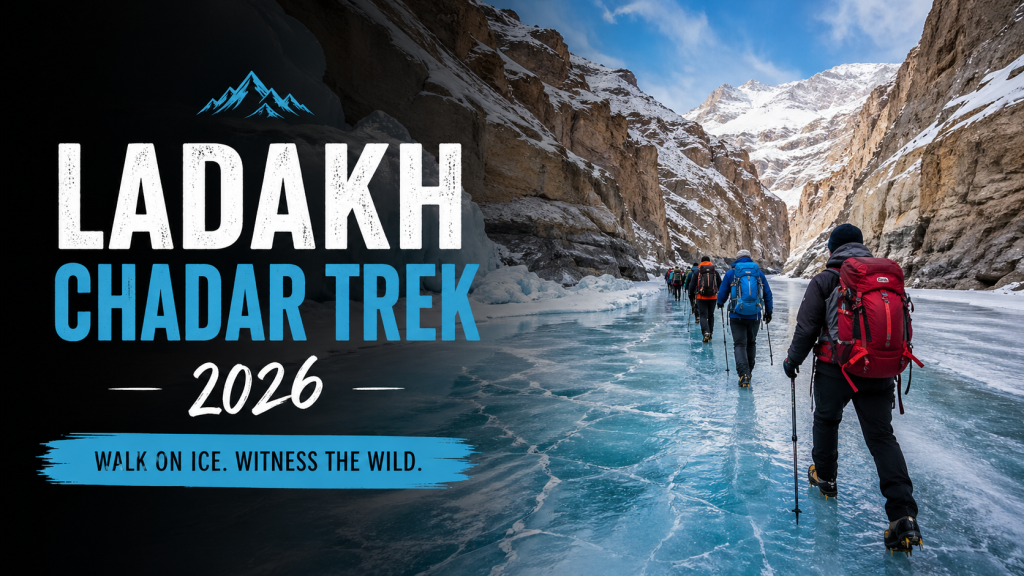
Overview: The Chadar Trek is one of those trekking experiences that exists in a category entirely of its own. “Chadar” means blanket , and in January and February, the Zanskar River freezes into a thick sheet of ice, creating a walking route through an ice canyon that has been used by Zanskar villagers for centuries to travel to Leh before the roads were built.
Walking on the frozen Zanskar River for 62 km through a canyon whose walls rise hundreds of metres above you, camping on ice shelves, watching frozen waterfalls hanging above the trail, and spending nights in temperatures of -20°C or below , this is not like any other trek in India. It is genuinely one of the world’s most extraordinary winter travel experiences.
The Chadar forms at night and partially melts during the day , every morning brings a different surface: sometimes thick and stable, sometimes thin and requiring careful navigation around open water, sometimes covered in fresh snow that softens your footsteps in the most eerie silence. The challenge is the cold, not the altitude , but the cold is extreme and demands proper preparation.
Highlights:
- Walking on the frozen Zanskar River , an experience that exists nowhere else in the world
- Frozen waterfalls hanging above the canyon walls
- Canyon walls hundreds of metres high on both sides
- Zanskar village culture , the communities that depend on this route
- Night camps on ice shelves at -20°C or below
Tips: Do NOT attempt this trek without proper gear: insulated boots rated to -30°C minimum, down sleeping bag rated to -20°C minimum, multiple base and mid-layers. Hire a local guide who has done the Chadar multiple times , the ice conditions change daily and the guide’s route-reading is genuinely critical for safety. The Chadar is only possible in January and February; climate change has made the frozen season shorter and less predictable in recent years.
10. Lamayuru to Darcha Trek
| Detail | Info |
| Altitude | 3,400m – 5,350m (11,150–17,550 ft) |
| Duration | 10–12 days |
| Best Season | July–September |
| Difficulty | Challenging |
| Cost | ₹22,000–₹38,000 per person |
| Distance | 100–110 km |
Overview: The Lamayuru to Darcha Trek is one of Ladakh’s great cross-range expeditions , a route that starts at the ancient Lamayuru Monastery and crosses the entire Zanskar range, finishing at Darcha in the Lahaul Valley (Himachal Pradesh). The trek crosses several passes above 5,000 metres and traverses remote terrain that includes the extraordinary landscape of the Zanskar Valley.
Highlights:
- Lamayuru Monastery , one of Ladakh’s oldest and most dramatically sited
- Multiple 5,000m+ pass crossings including Prinkiti La, Sisir La and Shingo La
- Remote Zanskar Valley sections , some of the least-visited terrain in the Indian Himalaya
- The final crossing into Himachal Pradesh , dramatic landscape transition from Ladakhi cold desert to Lahaul green valley
- Complete wilderness camping with pack horse support
Tips: This is a full expedition-style trek requiring full camping support. Weather windows are shorter than they appear at these altitudes , July to early September is the reliable window. A strong and experienced local guide is essential. Late September can bring early snowfall on the high passes.
11. Padum to Darcha Trek
| Detail | Info |
| Altitude | 3,600m – 5,090m (11,800–16,700 ft) |
| Duration | 8–10 days |
| Best Season | July–September |
| Difficulty | Challenging |
| Cost | ₹20,000–₹35,000 per person |
| Distance | 90–100 km |
Overview: The Padum to Darcha Trek connects the remote Zanskar Valley capital of Padum with Darcha in Lahaul via the high Shingo La Pass (5,090m). This is a classic trans-Himalayan crossing , from the harsh, ancient culture of Zanskar into the gentler green valleys of Himachal , and one of the most satisfying directional treks in the Himalayan system.
Highlights:
- Padum town , the capital of Zanskar, medieval-feeling, remote beyond description
- Zanskar Valley landscape , wider, more open than the gorge sections, enormous mountain walls
- Shingo La (5,090m) , dramatic high pass with views across the Zanskar and Lahaul systems
- Baralacha La visible in the distance from the pass
- The culture shock of arriving in Darcha from Zanskar , two completely different worlds
Tips: Most trekkers combine this route with the Jhunglam/Hemis–Padum route for a full 3-week Zanskar expedition. Individually, it is best approached from the Padum end (fly Leh, drive Padum, trek to Darcha and drive to Manali) as this saves the very long drive to Padum on the front end.
12. Kang Yatse and Dzo Jongo Peak Expedition
| Detail | Info |
| Altitude | 3,500m – 6,400m (11,500–21,000 ft) |
| Duration | 12–14 days |
| Best Season | July–September |
| Difficulty | Very Challenging / Technical |
| Cost | ₹40,000–₹75,000 per person |
| Distance | 90–100 km (including approach) |
Overview: Kang Yatse (6,400m) and Dzo Jongo (6,280m) are the twin peaks of the Markha Valley , two 6,000-metre summits that provide the definitive high-altitude mountaineering experience in Ladakh for expedition trekkers who want to cross the 6,000-metre barrier.
Dzo Jongo is a hidden 6,000m peak located in the Markha Valley, beside Kang Yatse. It is Kang Yatse’s lesser-known cousin and is considered more accessible , not requiring the full technical commitment of Kang Yatse but still demanding crampons, ice axes, and experience traversing high-altitude glaciers. From the summit, you get excellent views of Kang Yatse, Stok Kangri, Changthang Valley mountains, and the Karakoram range in the distance.
The trek takes you through not one but three high passes , Shiul, Chak, and Kongmaru La , making the approach alone a formidable experience.
Highlights:
- 6,000m summit experience , the Kang Yatse/Dzo Jongo summits are among the most accessible 6,000m peaks in India
- Markha Valley approach , one of Ladakh’s finest valleys on its own merits
- Summit views of the Karakoram, Zanskar and Ladakh ranges simultaneously
- Nimaling high camp , one of the finest camp settings in all of Ladakh
- Technical mountaineering experience without requiring prior Himalayan expedition history (for Dzo Jongo)
Tips: Technical equipment (crampons, ice axe, harness, helmet) is required and must be organised in advance from Leh. An experienced high-altitude guide with proper expedition credentials is non-negotiable for these peaks. First-time 6,000m climbers should target Dzo Jongo before Kang Yatse.
13. Stok Kangri Trek
| Detail | Info |
| Altitude | 3,500m – 6,153m (11,500–20,187 ft) |
| Duration | 8–10 days |
| Best Season | July–mid September |
| Difficulty | Very Challenging |
| Cost | ₹20,000–₹38,000 per person |
| Distance | 55–65 km |
Overview: Stok Kangri (6,153m) was once the most climbed high-altitude trekking peak in India , and its reputation as a non-technical 6,000m objective attracted thousands of trekkers seeking their first summit of this altitude class.
Critical 2026 note: Stok Kangri summit access is currently banned by the Ladakh administration and the wildlife department to allow the region to recover from the environmental stress caused by decades of overcrowding. The ban means you cannot currently reach the Stok Kangri summit , check current permit status with the Leh Tourism Office or your operator before booking, as restrictions may be updated. The trek route to the base and through the Stok range continues to offer extraordinary terrain.
Highlights (for the route, not the currently restricted summit):
- Stok Village and Stok Palace , a beautiful approach through one of Leh’s finest villages
- Mankorma Glacier , extraordinary high-altitude glacier scenery
- Stok La views , the Indus Valley and the full Ladakh panorama from the ridge
- Physical challenge of high-altitude trekking on some of Ladakh’s most dramatic terrain
Best Season for Trekking in Ladakh
| Month | Best For | Conditions |
| January–February | Chadar Trek, Snow Leopard Trek | Extreme cold (-20°C+), frozen river, exceptional winter experience |
| May | Early season easy routes (Sham Valley), acclimatisation | Snow clearing at passes, cooler temperatures, quiet trails |
| June | Most routes opening, Markha Valley, Lamayuru routes | Best month for early season, some snowmelt crossings |
| July | All routes fully open, peak season | Warm days, all passes accessible, popular routes busy |
| August | All routes open, warm | Excellent conditions, some afternoon showers in rare cases |
| September | Outstanding , the finest trekking month | Cool, clear skies, golden light, fewer trekkers, superb conditions |
| October | Early October still good at lower routes | Late month sees pass closures beginning, plan carefully |
The best overall window for Ladakh trekking is June to September. Of these, September is the outstanding month , cooler temperatures, extraordinary light, dry trails, and noticeably fewer trekkers on even the popular routes.
Ladakh Trekking Cost , Honest 2026 Breakdown
| Trek Type | Budget (self-guided) | Mid-range (guided) | Full package |
| Per day in Ladakh | ₹1,500–₹3,000 | ₹4,000–₹7,000 | ₹6,000–₹12,000 |
Individual Trek Package Costs (Per Person)
| Trek | Approximate Cost |
| Sham Valley Trek (3–4 days) | ₹8,000–₹15,000 |
| Lamayuru to Alchi (4–5 days) | ₹12,000–₹20,000 |
| Markha Valley Trek (7–8 days) | ₹18,000–₹28,000 |
| Lamayuru to Chilling (6–7 days) | ₹15,000–₹22,000 |
| Chadar Trek (8–9 days) | ₹16,000–₹28,000 |
| Snow Leopard Trek (10–12 days) | ₹35,000–₹55,000 |
| Hemis to Padum Trek (14–16 days) | ₹28,000–₹50,000 |
| Lamayuru to Darcha (10–12 days) | ₹22,000–₹38,000 |
| Kang Yatse/Dzo Jongo Expedition | ₹40,000–₹75,000 |
Guided packages typically include: licensed guide, cook, pack horses/porters, all camping equipment, all meals on trail, and Hemis National Park permit where applicable. Flights to Leh and accommodation in Leh before and after the trek are usually separate.
Additional Costs to Budget For
| Item | Cost |
| Hemis National Park permit | ₹25/person/day (Indian) |
| Inner Line Permit (where required) | ₹590 per person |
| Licensed guide (per day) | ₹1,200–₹2,000 |
| Porter (per day) | ₹800–₹1,200 |
| Pack horse (per day) | ₹1,000–₹1,500 |
| Camping equipment rental (full set) | ₹500–₹1,000 per day |
Tips for Trekking in Ladakh
- Acclimatise in Leh for 2–3 days before any trek: This is the single most important step. Leh sits at 3,500 metres , arriving and immediately starting a trek is how altitude sickness happens. Rest on Day 1, take a gentle walk on Day 2, and begin your trek on Day 3 or 4 at the earliest.
- Follow the “Climb High, Sleep Low” rule: On multi-day treks, try to gain altitude during the day but camp lower than your highest point. This facilitates acclimatisation and reduces night-time altitude sickness. Good route planning by an experienced guide builds this in automatically.
- Hire a licensed local guide , always: Ladakh’s trails are not always well-marked. Weather can change rapidly. A licensed local guide knows the terrain, the conditions, emergency escape routes, and the local communities. They add safety and depth to the experience simultaneously.
- Carry more water than you think you need: Dehydration at altitude accelerates exhaustion, headaches and altitude sickness. Carry a minimum of 3 litres on any trekking day. Water purification tablets are essential for drinking from stream sources on the trail.
- Pack for extreme temperature variation: Daytime June temperatures in Ladakh can reach 25°C in the valley. Night temperatures at high camps can drop to -5°C or below. Carry layers: thermal base, fleece mid-layer, down or synthetic insulation, windproof outer shell. You will use all of them.
- Carry a comprehensive first-aid kit and know how to use it: Remote Ladakh trekking means emergency medical help can be many hours away. Carry: blister treatment, bandages, antiseptic, pain relief, ORS sachets, altitude medication (Diamox , consult doctor in advance), and any personal prescriptions.
- Do not trek alone on remote routes: For routes like the Jhunglam (Hemis–Padum) or the high-pass crossings of the Lamayuru–Darcha system, trekking without a guide and support team is genuinely dangerous. Even experienced Himalayan trekkers should have local support in Ladakh’s remote terrain.
- Get travel insurance with high-altitude trekking and emergency evacuation cover: This is non-negotiable for any serious Ladakh trek. Helicopter evacuation from remote areas is expensive , ensure your policy covers it up to at least 6,000 metres.
- Register your trek with the District Tourism Office in Leh: For any remote multi-day trek, register with the Leh Tourism Office before departure. This creates an official record of your planned route and return date , essential for search and rescue response if anything goes wrong.
- Respect the environment , carry out all waste: Ladakh’s trekking routes have suffered from the accumulation of non-biodegradable waste. Carry your own reusable water bottles, refuse single-use plastics, and carry all packaging out of the trail. The Ladakh UT government has implemented strict plastic bans , respect them actively, not just technically.
Conclusion
Trekking in Ladakh is one of the most rewarding things an outdoor traveller can do in India , and one of the most important things to do thoughtfully. The altitude demands respect. The remoteness demands preparation. The landscape rewards both.
From the three-day Sham Valley homestay walk that eases first-timers into Ladakh’s extraordinary world, to the 16-day Hemis–Padum Zanskar crossing that tests experienced trekkers fully, to the frozen January walking on the Zanskar River that no other experience on earth replicates , there is a Ladakh trek for every level of ambition and fitness.
Come prepared, hire local expertise, acclimatise seriously, and walk slowly. The mountains will do the rest.
Planning a trekking trip to Leh Ladakh? Go2Ladakh.in offers custom trekking packages across all difficulty levels , with licensed guides, full camping support, permit assistance and verified logistics for every route in this guide. [Plan your Ladakh trek →]
Frequently Asked Questions About Trekking in Ladakh
Q1. What is the best season for trekking in Ladakh?
June to September is the main trekking season for most routes. September is widely considered the finest month , cooler temperatures, clear skies, golden autumn light, and fewer trekkers on the popular routes. The Chadar Trek and Snow Leopard Trek operate exclusively in January–February and offer completely different but equally extraordinary experiences.
Q2. How much does trekking in Ladakh cost?
Ladakh trekking cost varies significantly by route and format. Budget self-guided trekkers spend approximately ₹1,500–₹3,000 per day. Mid-range guided packages run ₹4,000–₹7,000 per day. Full guided packages including all logistics typically range from ₹15,000 for a 3-day Sham Valley Trek to ₹75,000+ for a Kang Yatse expedition. The Chadar Trek with reputable operators costs ₹16,000–₹28,000 for 8–9 days.
Q3. Is trekking in Ladakh suitable for beginners?
Yes , with the right trek selection. The Sham Valley Trek (3–4 days) is specifically designed for first-time trekkers and those new to altitude. The Lamayuru–Alchi route is also accessible to motivated beginners. The critical requirement for all Ladakh treks is acclimatisation , 2–3 full rest days in Leh before starting any trail, regardless of fitness level.
Q4. Do I need a guide for trekking in Ladakh?
For easy routes like the Sham Valley Trek, experienced trekkers can self-guide. For moderate and challenging routes , particularly the Markha Valley, Hemis–Padum, Lamayuru–Darcha and any peak expedition , a licensed local guide is strongly recommended for both safety and quality of experience. A good guide adds local knowledge, cultural context, emergency skills, and route security that no guidebook fully replicates.
Q5. Is Stok Kangri Trek open in 2026?
As of 2026, Stok Kangri summit access remains banned by the Ladakh administration to allow environmental recovery from decades of overtrekking. Check current status with the Leh Tourism Office or a licensed Leh-based operator before booking any package that includes the Stok Kangri summit. The trek route to the Stok range and base area may have updated regulations, confirmed locally before planning.
Trending Blogs
Similar Blogs
7-Day Ladakh Itinerary for September: Leh, Nubra Valley & Pangong Lake
One full week is enough to get a good first look at Ladakh, as long as you don’t try to cover half the region in seven days. This Ladakh itinerary 7 days plan keeps things simple: two days around Leh, followed by Nubra Valley and Pangong Lake, before returning back to Leh.
10 Reasons September Is One of the Best Months to Visit Ladakh
If you have been waiting for the right time to visit Ladakh, September deserves a place on your list. Ladakh in September has a slightly different feel from the busy summer months. The skies are clearer, the evenings start getting cold, the roads feel more peaceful and the landscape slowly begins to change with the season.
Where You Stay in Leh Ladakh
The single most confusing part of planning a Ladakh trip, after sorting out permits and altitude medicine, is figuring out where to actually stay. Leh is not a large city, but it has distinct neighbourhoods that feel completely different from each other. Stay in the wrong area for your travel style and you will spend your acclimatisation days walking uphill in thin air when you should be resting. Stay in the right one and your base will quietly make everything easier.
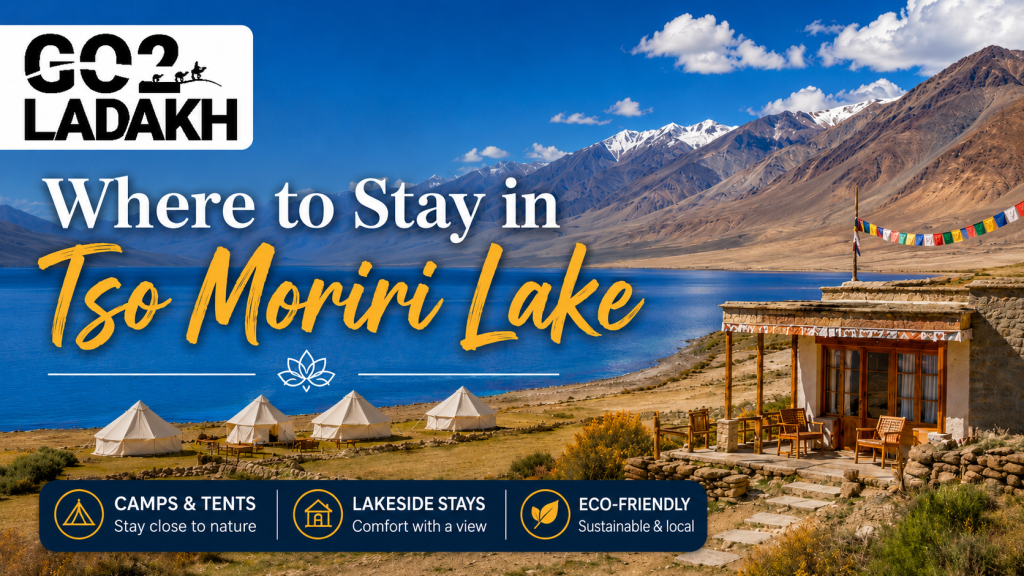
Where to Stay in Tso Moriri Lake: Complete Guide 2026
Where you stay at Tso Moriri matters in a way that is different from any other destination in Ladakh. This is not a question of choosing between a good and a better hotel. It is a question of understanding what kind of experience you want from one of the most remote overnight stops in India, and being honest with yourself about what you can comfortably handle at an altitude of 4,500+ metres with no mobile network, no ATM, and temperatures that plunge to 0°C or below every night, even in July.
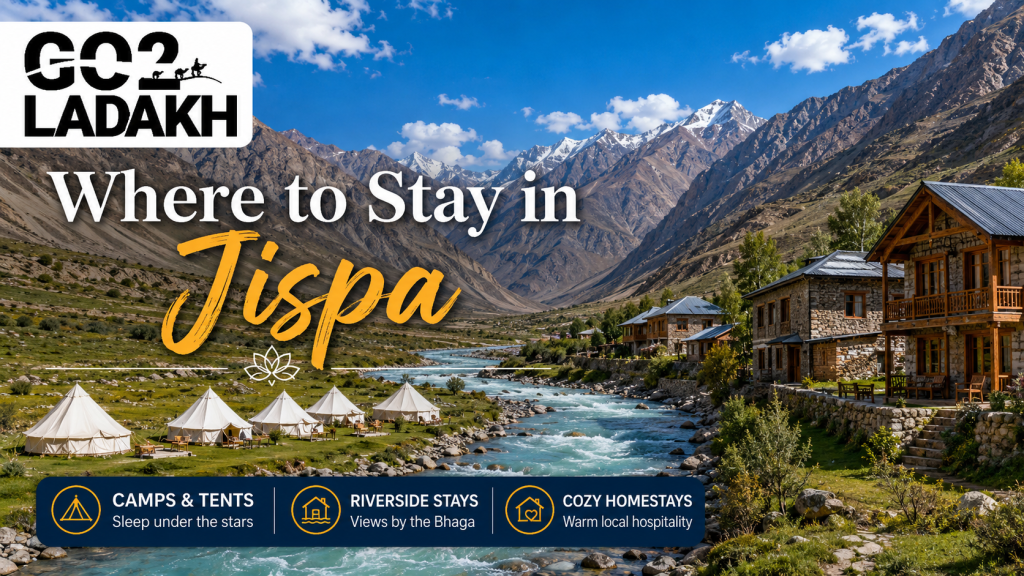
Where to Stay in Jispa: Best Hotels, Camps & Guide
Jispa is one of those places that most people pass through without really stopping — and later wish they had stayed longer. This quiet, compact village in the Lahaul Valley of Himachal Pradesh sits on the banks of the Bhaga River at 3,200 metres (10,500 feet), with snow-streaked peaks rising on every side and a silence so complete that you can hear the river from anywhere in the village.
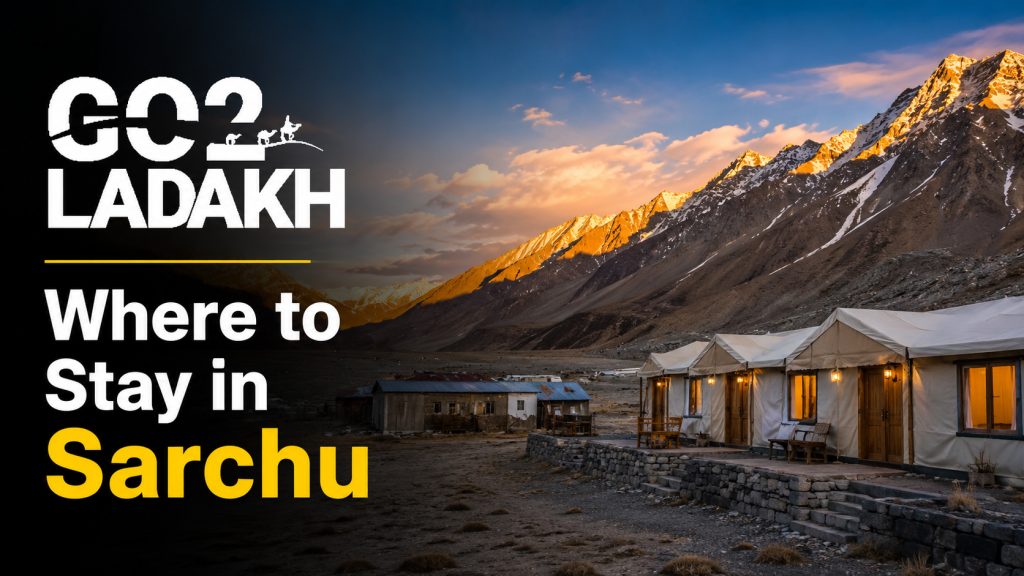
Where to Stay in Sarchu: Best Camps, Hotels & Complete Guide
Planning the complete Manali to Leh road trip? Go2Ladakh.in builds end-to-end Manali–Leh itineraries with curated overnight stops at Jispa or Sarchu, Leh hotel bookings, and real-time road status updates.
Adventure in Ladakh: Top 12 Sports & Activities Guide
Ladakh is not just a destination , it is an experience that pushes your limits, rewards your courage, and leaves you with memories that last a lifetime. Perched at an average altitude of 3,500 metres in the lap of the Himalayas and the Karakoram Range, adventure in Ladakh comes in every form imaginable , from roaring glacial rivers and ancient trekking trails to high-altitude cycling, traditional archery, and even bungee jumping over the Zanskar River.
Mountain Biking in Ladakh: Top Routes, Tips & Complete Guide 2026
Mountain biking in Ladakh is one of those experiences that sits in a category of its own , not just in India, but anywhere on earth.
You are pedalling through a high-altitude cold desert at 3,500 to 5,000 metres, with glaciated peaks on every horizon, ancient monasteries on cliff faces above you, and roads so quiet that the sound of your own tyres on gravel is the loudest thing for miles. The landscape is dramatic in a way that no photograph fully captures. The air is thin. The climbs are genuinely hard. The descents are the kind that make experienced riders stop to catch their breath and take it all in.